
Tuesday, March 30, 2010
Mac Attacks


Monday, March 29, 2010
Etymologist and Chess Player

Chess and other puzzle-solving activities seem to attract people of the same habits of mind: people who, when faced with a mystery, feel compelled to figure it out (no matter what else they should be doing). I touched on this subject in "Why Chess Sticks," where I suggested that the game continually presents those who study it with "knowledge gaps." As each new gap is filled a new one opens up, so we are continually drawn into new mysteries to explore. That abyss of ever expanding problems to solve represents both the attraction and the danger of the game. To outsiders, the danger is significant, since chess players out to solve a chess mystery seem to be tilting at windmills (as the "Knights Errant" well know).
Thinking about these issues, I was naturally intrigued by Michael Brick's "Etymologist on a word quest, from 'Big Apple' to 'Dallas'" (The Dallas Morning News, March 28, 2010), which tells the story of amateur word sleuth and chess master Barry Popik, best known for tracing the origins of the term "Big Apple" to describe New York City. The story of Popik's quest to solve the mystery of "The Big Apple" is well told -- beginning with his motives for taking it up:
Thinking about these issues, I was naturally intrigued by Michael Brick's "Etymologist on a word quest, from 'Big Apple' to 'Dallas'" (The Dallas Morning News, March 28, 2010), which tells the story of amateur word sleuth and chess master Barry Popik, best known for tracing the origins of the term "Big Apple" to describe New York City. The story of Popik's quest to solve the mystery of "The Big Apple" is well told -- beginning with his motives for taking it up:
[Popik thought:] "I'll answer the question about the Big Apple; it's the most asked question at the New York Public Library. People asked about it because there wasn't an answer – this was before the Internet – and I'll answer it and the mayor will give me a gold medal."
After a considerable amount of squinting into microfilm, Popik tracked the term far beyond its use as a tourism slogan in the 1970s, all the way to 1920s horse racing writer John J. Fitz Gerald, who had likely appropriated it from New Orleans stable hands.
He scoured reports from the winter racing season, a feat of diligence at which mainstream researchers would later marvel. His work, which would eventually become grist for an eight-part series on his Web site (one part is called "1970s-present: False Etymologies"), gained the attention of prominent lexicographers.
"The Big Apple racing circuit had meant 'the big time,' the place where the big money was to be won," Popik wrote. "Horses love apples, and apples were widely regarded as the mythical king of fruit."
Respectful citations followed, but no gold medal.
Popik's story may be every chess player's story. Some of us just take on problems that other people care about enough to give out gold medals....
Sunday, March 28, 2010
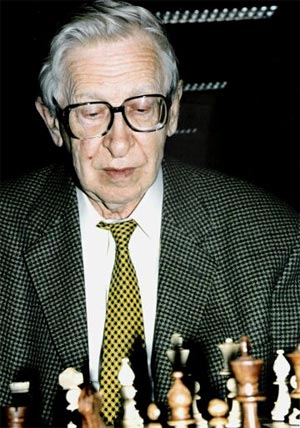
Vasily Smyslov (1921-2010)
Friday, March 26, 2010
Marshall's 1.d4 d5 2.c4 Nf6!?
Rick Kennedy's well-researched Alekhine vs. Marshall's 1.d4 d5 2.c4 Nf6!? at ChessCafe (originally in Kaissiber #27) would almost lead you to believe that Frank James Marshall's center-surrendering experiment against the Queen's Gambit might be fully playable. Alekhine's notes on Alekhine - Marshall, Baden Baden 1925 suggest as much, and 12…Nxe5 13.0-0 0-0 14.Be2 Be6 would clearly have improved on Marshall's play. However, there are two lines that Kennedy does not consider which seem to keep the line in doubt, and both are examined in Matt Pullin's excellent two-part video series from 2008 (see above).
I always admire Pullin's objectivity, and he does his best to demonstrate Black's chances as well as White's most powerful challenge with 1.d4 d5 2.c4 Nf6 3.cxd5 Nxd5 4.Nf3! (objectively better than the natural 4.e4 Nf6! 5.Nc3 e5!) 4...Bf5 5.Qb3! and if 5...Nc6 6.Nbd2! gives White a strong variation of the Baltic (1.d4 d5 2.c4 Bf5), as demonstrated in the game Takacs-Havasi, Budapest 1926. Kennedy also does not mention the game Alekhine - Mooyman/Citroen, Surabaya 1933 (surprising, given his focus on Alekhine) where White was definitely better following 1.d4 Nf6 2.c4 d5 3.cxd5 Nxd5 4.e4 Nf6 5.Nc3 e5 6.Nf3 exd4 7.Nxd4 (7.Qxd4 is also slightly in White's favor). Pullin suggests Black may have a playable game here after 7....Bc5 8.Be3 O-O (better than the tempting but tempo-wasting 8...Ng4?! as Alekhine's opponents tried) and if 9.Ne6 Bxe6 10.Bxc5 (gaining the two Bishops in an open position) 10...Re8 11.Qxd8 Rxd8 he thinks Black has reasonable chances, which may be true, though Black's position is hardly inspiring. Conclusion: Marshall's variation of the Queen's Gambit Declined may have more to it than commonly thought, but it does not inspire confidence against White's best counters.
Thursday, March 25, 2010
Caro-Kann Defense, Fantasy Variation

White has a "fantasy" that features 3...dxe4?!
There has been a lot of interest of late in the Caro-Kann Fantasy Variation (1.e4 c6 2.d4 d5 3.f3!?), which is looking more and more like one of the more viable alternative to the more mainstream Advance Variation (3.e5), Classical (3.Nd2 or 3.Nc3) and Exchange / Panov Attack (3.exd5). Though there was Nikolai Minev's decades-old pamphlet Caro-Kann, Fantasy Variation and Nigel Davies chapter in Gambiteer I (see games at Chessgames), the line otherwise seems mostly discussed in books from the Black perspective (including by Ian Rogers in SOS #3 on 1.e4 c6 2.d4 d5 3.f3 e5!?). It does seem a fertile territory for analysis since there is not yet a lot of theory and the lines can get very sharp (so computers can be of great assistance here). ChessBase points out the line's popularity in the recent European Individual Championships and has published a few articles from their ChessBase Magazine [which no longer appear at their website]. For those with subscriptions, I have also seen videos online by Bryan Smith (at ChessLectures.com), by Boris Alterman (at ICC) and by Nigel Davies for Foxy Videos. As my interest is piqued, I figured I'd put together a little webliography. As always, I welcome additions.
- Winning Moves in the Caro-Kann, Fantasy Variation by W.T. Harvey
A collection of puzzles from fantasy variation games might make for good tactical training. Also available in a more interesting form at Chess.com. - Preview: Gambit Guide: Caro-Kann, Fantasy Gambit by Boris Alterman
A good introduction to the basics of the line, especially for amateurs. You can see the complete series online at ICC if you are a member. - The Fantasy variation with 3.f3, Parts One, Two and Three, by kingscrusher
Uses three videos to discuss a particularly intricate game arising from the Caro Kann Fantasy variation with 3...e6 4.Nc3 Bb4 5.Be3. - Confusing Names by Sverre Johnsen
Discusses one of the author's losses as Black after 3...e6 4.Nc3 Bb4 5.Bf4 Nf6 6.Qd3 Qa5!? - Fantasy (Opening Lanes #13) by Gary Lane
Lane is a big fan of the Blackmar-Diemer, so he is naturally interested in the line as White. - Gibraltar Chess Festival with annotations by Sunil Weeramantry
You will find annotated the game Vachier-Lagrave-Zatonskih from the Gibraltar Chess Festival. Identical content available at Chessville. - Morozevich - Bologan, Russian League 2004 annotated by Boris Schipkov
Features 1. e4 c6 2. d4 d5 3. f3 e6 4. Nc3 Bb4 5. Bf4 Ne7 6. Qd3 b6. - NJKOs Lose to New York Knights by Michael Goeller
Annotates the game Benjamin-Kacheishvili, USCL 2009 with 3...Qb6!? - Canning the Caro, The Milner Barry Gambit, Part One and Part Two by Tim Mcgrew
Covers the 1.e4 c6 2.d4 d5 3.Nc3 dxe4 4.f3!? gambit originated by British GM Milner-Barry, which can transpose.
- Lawrence Trent
No longer on the web (nor in the Internet Archive):
- Fantasy Variation Analysis by Marcus Schmuecker at ChessBase Magazine Online
Analyzes the innovative 1.e4 c6 2.d4 d5 3.f3!? dxe4 4.fxe4 e5 5.Nf3 Bg4! 6.Bc4 Nd7 7.c3! (instead of 7.O-O first). This is probably the most important line to know since it is widely recommended for Black, including by Jovanka Houska in Play the Caro-Kann. - Fantasy Variation EICC from ChessBase
A collection of games featuring the line from the recent European Individual Championships. - Analysis by Alfredo Cueva at ChessBase
A reader's analysis of the line1.e4 c6 2.d4 d5 3.f3 dxe4 4.fxe4 e5 5.Nf3 Bg4 6.Bc4 Nd7 7.c3 b5 8.Bd3! - Nepomniachtchi-Jobava by Knaak at ChessBase
An interesting recent game from the European Ch that began with 3...Qb6 4.a4.
Subscribe to:
Posts (Atom)


